
Strategic sprint planning is the practice of breaking your annual strategy into short, timeboxed cycles that turn broad goals into prioritized initiatives, OKRs, and measurable roadmaps. Run correctly, it produces faster course correction and sharper resource focus than a once-a-year planning ritual ever will. The rest of this guide covers how to design a sprint, set the right cadence, measure results, and use AI tools without losing control of the process.
TL;DR:
- Sprint timeboxes of two to ninety days enable faster course correction compared to annual planning, especially in fast-moving markets.
- Effective sprints require clear goals, impact scoring, a limited initiative list, and defined decision rights to prevent drift into status meetings or wish lists.
- Regular review cadence, like monthly reviews and quarterly sprints, alongside strategic decision authority, improves resource reallocation and overall performance.
- AI tools should support specific bottlenecks in preparation, prioritization, measurement, and governance phases, with human oversight remaining essential for decision making.
- Starting small with three or fewer initiatives, with well-defined KPIs directly linked to goals, is crucial for a successful first strategic sprint.
Why Strategic Sprints Work Better Than Annual Planning
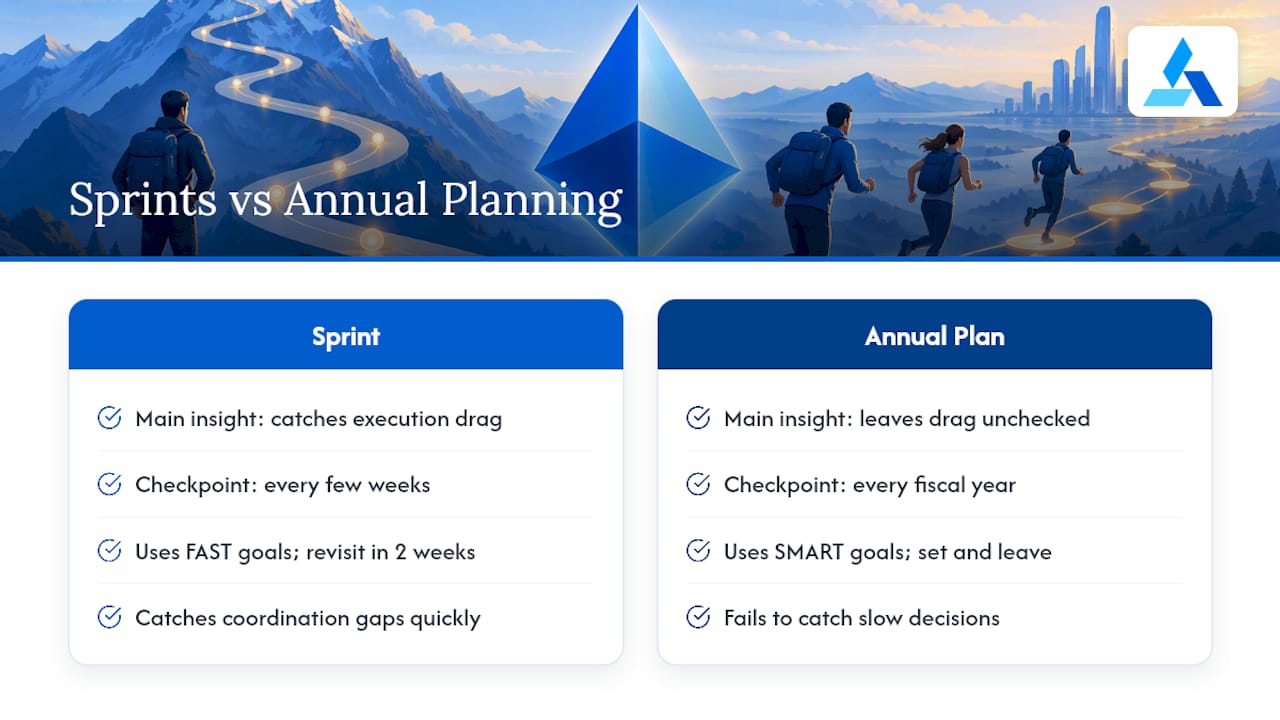
Most execution failures have nothing to do with the plan itself. Harvard Business Review found the real culprits are coordination gaps and decisions that move too slowly to matter. A strategy sitting in a slide deck for eleven months has no mechanism to catch that kind of drag. A sprint does, because it forces a checkpoint every few weeks instead of every fiscal year.
This is also why MIT Sloan Management Review argues FAST goals (frequently discussed, ambitious, specific, transparent) beat traditional SMART goals for anything you plan to revisit often. SMART goals are built to be set and left alone. FAST goals assume you will look at them again in two weeks, which is exactly the rhythm sprinted strategy runs on.
Sprinting beats annual planning specifically when your market moves fast, your feedback loops are short, or you need to move budget between initiatives mid-year rather than waiting for next year’s cycle. If your industry barely changes and your resource allocation is fixed twelve months out, you don’t need this. Most SMBs are not in that position anymore.
What Goes Into a Strategic Sprint
A sprint is not a brainstorm with a deadline attached. It needs the same structural discipline as any planning system, just compressed.
- Goals: Written as OKRs, phrased using FAST principles so they get discussed weekly, not filed away.
- Priority filters: Every candidate initiative gets scored on impact, effort, strategic fit, and risk before it earns a spot in the sprint.
- Timebox: Two weeks for a narrow tactical test, four to six weeks for a cross-functional initiative, ninety days for a full strategic slice. Longer than that and you’re back to annual planning with extra paperwork.
- Roles: A sprint owner who drives the cadence, cross-functional reviewers who represent each affected team, and a decision liaison who can actually authorize resource moves.
- Outputs: A short list of sprint OKRs, a prioritized initiative list, documented experiment hypotheses, and a 90-day roadmap slice that feeds the next cycle.
Skip any one of these and the sprint tends to drift into either a status meeting or a wish list. Neither moves the business.
How to Run Your First Strategic Sprint
You don’t need a consultant to run a first sprint. You need a sequence, and the discipline to stick to it.
- Prepare. Set your strategic anchor (the one objective this sprint serves), pull current market and competitor signals, name your stakeholders, and write two or three testable hypotheses for what the sprint should prove.
- Run. Hold a compact planning workshop, ideally half a day, not a week. Walk through the experiment plan, agree on decision gates (points where you stop and check results before continuing), and document every commitment in writing before the room breaks up.
- Measure. Pick two to four KPIs tied directly to your sprint OKRs, no more. Use a simple evidence-capture template so outcomes get logged as they happen, not reconstructed from memory afterward.
- Reallocate. Bring findings to your decision group. If an initiative earned more budget or headcount, move it. If it didn’t work, kill it before it absorbs another cycle of resources.
Pro Tip: Cap your first sprint’s initiative list at three items. Teams that try to sprint on ten priorities at once usually end up sprinting on none of them.
How Often Should You Run Sprint Reviews?
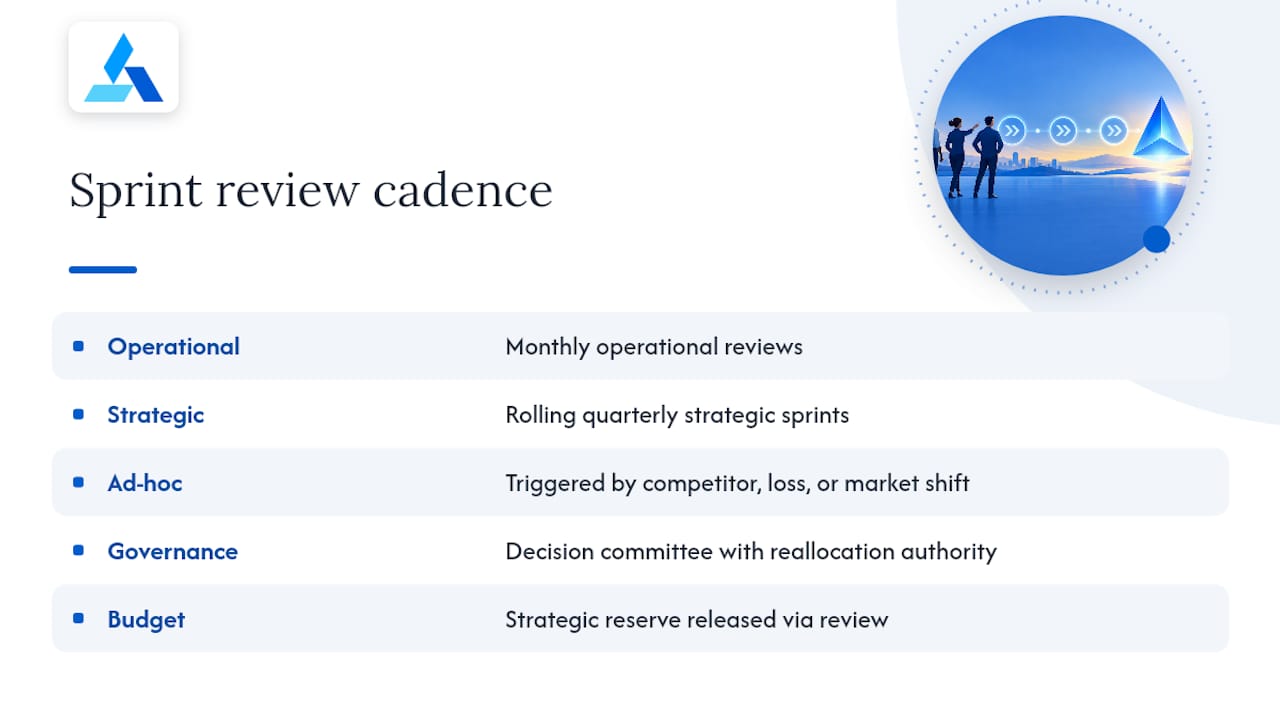
Cadence is where most sprint programs quietly fall apart, usually by running reviews too rarely to matter or too often to sustain. A workable rhythm for most SMBs looks like monthly operational reviews, a rolling quarterly wave of larger strategic sprints, and clear triggers (a competitor move, a lost account, a market shift) that justify an ad-hoc sprint outside the normal calendar.
Governance matters as much as timing. Someone, ideally a small decision or investment committee, needs explicit authority to reallocate funds between sprints. McKinsey’s research on tying short-term decisions to long-term strategy found that companies with compact planning timelines and in-year reallocation flexibility tend to outperform on growth and return on capital. A common practice is holding back a modest portion of the budget as a strategic reserve, released only through the sprint review process rather than spent on whatever came up first.
Where AI Actually Helps in Strategic Sprints
AI earns its place in a sprint when it removes a specific bottleneck, not because it’s fashionable to mention. Mapped against the sprint phases, the useful applications are narrow and concrete:
- Preparation: Market and competitor synthesis that would otherwise take a team day of manual research.
- Prioritization: Initiative scoring against your impact, effort, and fit filters, applied consistently instead of by gut feeling.
- Execution: Scenario modeling and live dashboards that flag when an initiative is falling behind its KPI.
- Governance: A documented trail of what the model recommended and what a human decided, which matters if anyone ever asks why a call was made.
That last point isn’t optional. The NIST AI Risk Management Framework is explicit that AI outputs should function as decision inputs a human reviews, not autonomous verdicts. Planview’s benchmark report backs this up from a different angle: leaders who centralize coordination on a single platform report far better course-correction ability than those juggling spreadsheets across departments. None of this works, though, without your finance, CRM, and project tools feeding one central strategy hub. Fragmented data is the fastest way to turn a sprint into a guessing exercise.
How Blue Prysm Fits Into a Strategic Sprint
Blue Prysm was built around the sprint recipe above, not a generic dashboard bolted onto old strategy software. During preparation, it delivers AI-driven market synthesis and automated competitor briefs instead of a team spending three days pulling that together manually. During prioritization, its scoring tools and strategy library, more than 50 frameworks deep, apply the same impact and fit filters your sprint needs instead of relying on whoever argues loudest in the room.
During measurement, execution dashboards track your OKRs and KPIs in one view, flagging drift before it becomes a wasted quarter. On governance, Blue Prysm runs on infrastructure built for secure data custody, which matters when your sprint decisions are informed by sensitive competitive intelligence you don’t want floating through five disconnected tools.
What I’ve Seen Sprints Get Wrong
Three traps sink most first attempts: teams sprint on too many initiatives at once, nobody holds real decision rights so nothing gets reallocated, and the KPIs chosen don’t actually connect to the sprint’s stated goal. The fix fits in one sentence: start small, make the goals public, set aside a modest reserve, and treat your first sprint as an experiment, not a verdict on the whole approach.
— Colin Bowdery
Ready to Pilot Your First Strategic Sprint?
Reading about sprint design and actually running one with real market data behind it are two different problems. Blue Prysm closes that gap by giving you the AI market intelligence, competitor tracking, and scoring tools your sprint recipe needs, without hiring a full consulting bench to get started. The Starter plan costs $30 a month or $299 a year; check the pricing page for details.
If you’d rather have someone map the sprint framework directly onto your current strategy, Blue Prysm’s AI Operational Audit does exactly that, identifying where coordination is breaking down before you commit budget to a full sprint program. Teams that want to build this muscle across a whole department can also work through Strategic Landscape or Framework Mastery training. Whichever route fits, the next step is the same: pick one initiative, set a 90-day timebox, and run your first sprint as a test rather than a bet-the-company decision.
Sources
- Planview — 2025 State of Strategy Execution Benchmark Report
- With goals, FAST beats SMART — MIT Sloan Management Review
- NIST — Artificial Intelligence Risk Management Framework (AI RMF)
- Tying short-term decisions to long-term strategy — McKinsey
FAQ
What Is Strategic Sprint Planning?
Strategic sprint planning breaks a broader business strategy into short, timeboxed cycles, usually two weeks to ninety days, that produce specific OKRs, prioritized initiatives, and a measurable roadmap slice. It’s a way to test and adjust strategy continuously rather than committing to a plan for a full year.
How Long Should a Strategic Sprint Last?
Most strategic sprints run two to six weeks for a single initiative, or up to ninety days for a broader strategic slice covering multiple workstreams. Shorter timeboxes suit tactical tests; longer ones suit cross-functional initiatives that need more coordination.
How Is Strategic Sprint Planning Different From Annual Planning?
Annual planning sets goals once and revisits them a year later, while strategic sprint planning reviews and reallocates resources every few weeks based on real results. McKinsey’s research links this kind of compact, in-year reallocation to stronger financial performance.
Does Blue Prysm Support Strategic Sprint Planning?
Yes. Blue Prysm’s platform maps directly to sprint phases with AI market intelligence for preparation, initiative scoring for prioritization, and execution dashboards for measurement. Pricing starts at $30 a month on the Starter plan, with consulting available through the AI Operational Audit for teams that want hands-on setup help.
What KPIs Should I Track During a Sprint?
Limit yourself to two to four KPIs tied directly to your sprint’s OKRs rather than tracking everything available. Fewer, tightly connected metrics make it easier to spot drift early and reallocate resources before a full cycle is wasted.