
Product OKRs should measure outcomes that change user behavior or business metrics, not shipped features. Start this quarter with one primary objective and 2 to 4 measurable key results, each with a baseline, a target, and a named owner. Score progress on a 0.0 to 1.0 scale, and treat a final score of 0.6 to 0.7 as the sweet spot for a genuinely ambitious key result. That is the whole system. Everything else is execution detail.
TL;DR:
- Focusing on one primary objective per quarter with up to three key results ensures manageable scope and clearer accountability for product teams.
- Key results should include a baseline, target, owner, and measurement method to create measurable, outcome-driven goals.
- Weekly scoring from 0.0 to 1.0 and monthly evidence-based reviews help teams maintain focus and adjust initiatives when progress stalls.
- Shipping features is a means to support outcomes, not an outcome itself; OKRs should measure behavior or metric changes instead.
- Maintaining a calendar-first rhythm and structuring reviews around a fixed schedule significantly improves OKR adherence and success rates.
Why Product Teams Use OKRs Instead of Just a Roadmap
A roadmap tells you what ships and when. OKRs answer a different question: did any of it actually work? That distinction gets lost constantly. A team ships twelve features in a quarter and calls it a win, while retention stays flat and nobody asks why.
OKRs force the “why” into the open. Instead of managing a list of outputs, teams commit to outcomes they can defend to a skeptical executive: a specific behavior change, a specific number that moved. This matters most in three situations.
- You are in a growth phase where distributed teams need to make calls without waiting on a single decision maker.
- The problem is genuinely uncertain, and you need a framework for placing measurable bets rather than guessing.
- Cross-functional alignment has broken down and engineering, design, and marketing are optimizing for different definitions of “done.”
Google’s re:Work research found that blending top-down priorities with bottom-up input is what makes teams actually own their OKRs, rather than treating them as a compliance exercise handed down from leadership. If your team can’t explain in one sentence why an objective matters to the business, that objective is not ready to ship.
How to Write Product OKRs That Measure Outcomes
Most teams get stuck at the same step: turning a vague ambition into a measurable commitment. Here is the workflow to run during planning week.
- Anchor to one outcome you control. Look at the company or quarterly priority list and pick the single product outcome your team can move without depending on three other departments. Resist the urge to address everything at once.
- Draft one primary objective, cap total objectives at three. Product OKR templates consistently show 2 to 4 key results per objective works better than a longer list. More than that and nobody remembers what they’re accountable for by week three.
- Write each key result with four parts: baseline, target, owner, and measurement method. “Improve onboarding” is not a key result. “Increase Day 7 activation from 34% to 45%, measured via the activation event in the analytics pipeline, owned by the growth PM” is.
- Pressure-test the target for real stretch. If your team is confident they will hit 100%, the target is too safe. Calibrate toward the 0.6 to 0.7 scoring range that Atlassian’s OKR playbook treats as the mark of a properly ambitious goal.
- Lock the operating rhythm before you start executing. Decide now whether scoring happens weekly, reviews happen monthly, and grading happens at quarter’s end. Teams that skip this step end up inventing the cadence mid-quarter, which is when OKRs quietly die.
Pro Tip: Write the measurement method into the key result itself, not into a separate tracking doc. If the “how we’ll know” lives somewhere else, it gets forgotten by the second week.
Product OKR Examples You Can Adapt This Quarter
Borrowing a proven skeleton beats staring at a blank template. Here are five structures pulled from common product scenarios, each built around an outcome rather than a task list.
- Activation: Objective: “New users experience value faster.” KR: Increase Day 7 activation rate from 34% to 45%, tracked via the onboarding funnel dashboard, owned by the activation PM.
- Retention: Objective: “Customers stay because the product keeps earning its place.” KR: Reduce monthly logo churn from 4.2% to 3.0%, measured through the billing system’s cancellation report, owned by the retention lead.
- Launch: Objective: “The new feature earns a place in the daily workflow.” KR: Reach 25% weekly adoption among eligible accounts within 60 days, and hold NPS for adopters at 40 or above, owned by the feature PM.
- Quality: Objective: “The product feels dependable under real load.” KR: Cut checkout error rate from 2.1% to under 0.5%, tracked via error logging, owned by the platform engineer.
- Discovery: Objective: “We know whether this bet is worth building.” KR: Run three prototype tests and set a clear decision threshold, such as a 15% conversion lift, before committing engineering resources.
Notice what’s missing: “ship X feature” never appears as a key result. Shipping is an initiative that might support one of these outcomes, but it never gets to stand in as the outcome itself.
Running the OKR Cadence Without Losing the Thread
Setting good OKRs is the easy part. Keeping them alive through a busy quarter is where most teams actually fail.
- Weekly check-in: each key result gets a single score from 0.0 to 1.0, plus one line of status. No debate, no essay. This lightweight ritual is exactly what Atlassian recommends to catch drift before it becomes a crisis.
- Monthly deep review: pull up the evidence behind each score and ask whether the underlying assumption still holds. This is where you decide to adjust an initiative, not the key result itself.
- Roadmap mapping: every initiative on the roadmap should trace back to a key result it’s meant to move. If a feature can’t answer “which KR does this support,” it doesn’t belong on this quarter’s roadmap.
- Rework vs. reroute: change the initiative first when a KR is stalling. Only rewrite the KR itself if the original assumption was wrong, not just because progress is slow.
Pro Tip: Build your check-ins around a fixed calendar slot before the quarter starts, not around whenever the team remembers. A calendar-first cadence is the single biggest predictor of whether a team’s OKRs survive past week four.
Tools like Power BI scorecards can surface KR progress visually so the monthly review starts from evidence instead of memory.
Common Product OKR Mistakes and How to Fix Them
Most OKR failures trace back to a small set of repeat offenders.
- Activity-based KRs. “Ship 5 features” measures effort, not impact. Reframe it as the behavior change those features are supposed to cause.
- Verbatim cascading. Copying the company objective word for word onto the product team’s OKR skips the translation step. Dovetail’s research on product team OKRs makes the case plainly: team OKRs should relate to organizational goals, but the cross-functional team doing the work needs to define them.
- Too many objectives. Five objectives with three KRs each isn’t ambition, it’s diluted focus. Keep the count tight.
- Blending OKRs into performance reviews. The moment a stretch goal becomes a personal grade, people stop setting stretch goals.
How Many Objectives and Key Results Should a Product Team Run?
One primary objective per quarter, with a hard ceiling of three, is the range that shows up across most practical product OKR templates. Each objective should carry 2 to 4 key results, never more. That’s not an arbitrary limit. It’s the number of things a team can actually hold in working memory across a 12 week quarter without losing focus on the highest priority bet.
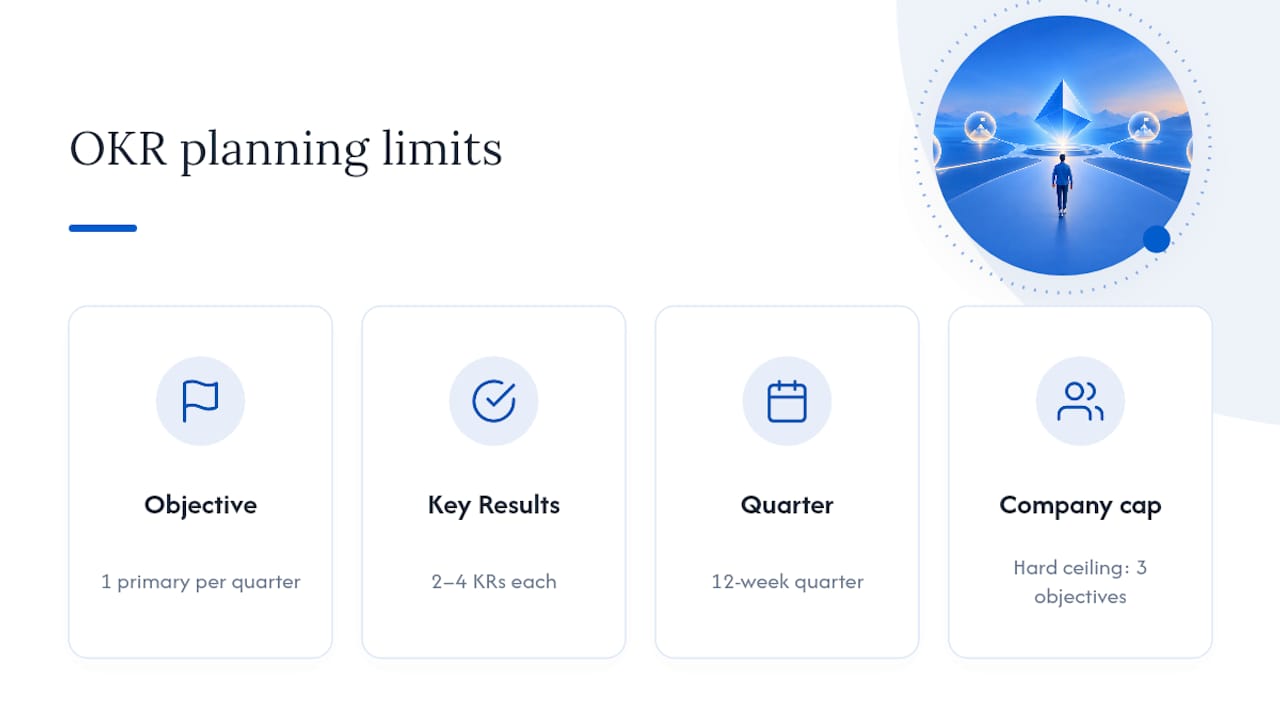
The math matters more than it looks. Four objectives with four key results each means sixteen separate metrics competing for attention every single week. Nobody scores sixteen things with any rigor. They skim, they guess, and the ritual collapses into theater.
Company-wide, the same discipline applies at a different scale: two or three top-level objectives, each supported by team-level OKRs that translate intent rather than copy language verbatim. A product team’s OKR should answer, in one sentence, how its outcome supports the company’s outcome. If that sentence takes a paragraph to construct, the OKR was set in isolation, and it will feel disconnected from company priorities by week six. Stakeholders outside product, including sales and marketing, should be able to read your objective and immediately see which piece of the bigger picture it moves. That visibility is usually the difference between a product team viewed as strategic and one viewed as a feature factory.
Colin Bowdery on Running Product OKRs That Actually Stick
Most OKR failures aren’t about writing bad objectives. They’re about scheduling failures. Teams write great key results in a planning workshop, then never build a calendar slot to revisit them, so the whole system quietly dies by week five.
Three facilitation moves fix most of this: put the weekly score on a recurring calendar invite before the quarter starts, keep the monthly review under 30 minutes and evidence only, and ban any debate about whether a score is “fair.” Scores describe reality, they don’t get negotiated.
Teams running a calendar-first cadence see meaningfully better OKR completion, and structured facilitation training closes the gap between a team that writes good OKRs once and one that runs them every quarter.
— Colin Bowdery
Where Product OKR Discipline Meets Better Strategic Planning
Writing sharp OKRs gets you halfway. The other half is knowing whether your baseline, your target, and your competitive read on the market are actually grounded in reality, not gut feeling. That’s the gap Blue Prysm closes for product teams who want their OKRs backed by more than a spreadsheet and a hunch.
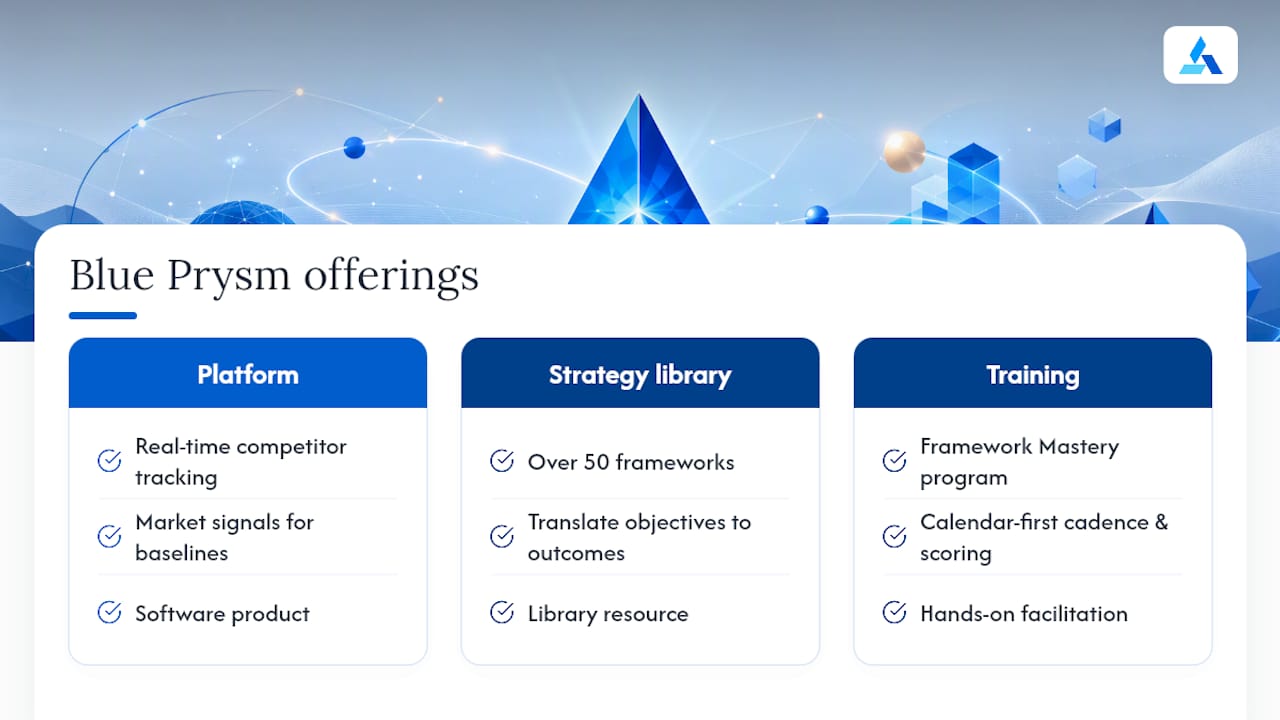
Blue Prysm’s market analysis platform gives product teams real-time competitor tracking and market signals, so the baseline you write into a key result reflects what’s actually happening outside your building, not just inside your analytics dashboard. The strategy library adds over 50 frameworks you can pull from when translating a company objective into a defensible team-level outcome, instead of cascading it word for word. For teams that want hands-on facilitation rather than a self-serve tool, Blue Prysm’s Framework Mastery training builds the same calendar-first cadence and scoring discipline into your team’s operating rhythm.
Plans start at $30 a month for Starter, with Pro and Enterprise tiers for teams that need deeper competitive intelligence and execution dashboards. Check current pricing and find the plan that fits your team’s next planning week.
Sources
For deeper templates and scoring guidance, consult the Atlassian OKR playbook, Google’s re:Work goal-setting guidance, and IdeaPlan’s free product OKR template.
- OKR Guide & Template | Learn How to Set Team Goals | Atlassian
- Set goals with OKRs | re:Work (Google)
- OKRs for product teams | Dovetail
FAQ
What’s the difference between an objective and a key result?
An objective is the qualitative outcome you’re chasing, like “users find value faster.” A key result is the measurable proof that outcome happened, with a baseline, target, and owner attached, as outlined in ClickUp’s product OKR framework.
How many OKRs should a product team have per quarter?
One primary objective with up to three total, and 2 to 4 key results per objective, is the practical range most product teams use successfully. Going beyond that dilutes focus and makes weekly scoring unmanageable.
What does a 0.7 OKR score actually mean?
A 0.7 means the team came very close to hitting an ambitious stretch target, which Atlassian’s scoring rubric treats as a healthy result. A perfect 1.0 usually signals the target wasn’t ambitious enough to begin with.
Should OKRs replace the product roadmap?
No. OKRs measure the outcome you’re trying to achieve, while the roadmap coordinates the initiatives meant to get you there. Every roadmap item should trace back to the key result it supports.
Does Blue Prysm offer OKR templates for product teams?
Yes. Blue Prysm’s strategy library includes OKR and KPI tracking tools alongside more than 50 frameworks, and the pricing page lists current plans starting at $30 a month for the Starter tier.