
The fastest path to reliable results is a pilot anchored in a signed leadership strategy, run on a weekly execution cadence with quarterly reviews as advised in Technology adoption: a decision-maker’s playbook – POW IT UP. Treat the first two cycles as a controlled test, not a company-wide mandate, and expect 3 to 4 quarters before the system runs on its own. Your next move: book a half-day strategic anchoring session this week and name a sponsor and an OKR champion before you write a single key result.
TL;DR:
- Running a two-quarter pilot with clear scope and leadership buy-in is essential before expanding OKRs across more teams.
- A strategic anchoring session with 3 to 5 objectives and signed off objectives ensures alignment and focus for the entire organization.
- Effective key results must include a baseline, target, owner, and evidence link to avoid activity-based metrics that do not measure outcomes.
- Building a regular execution cadence with weekly check-ins, cross-team syncs, and leadership reviews increases accountability and maintains momentum.
- Proper training for managers and transparent communication of OKRs foster honesty, trust, and continuous process improvement over multiple cycles.
OKR Implementation Overview: The Roadmap and Pilot Checklist
Before you touch a spreadsheet or a software trial, get five things on paper. Skip any one of them and your pilot will feel busy without producing anything you can point to in a boardroom.
- A one-page strategy anchor with 3 to 5 company objectives everyone can recite
- A defined pilot scope (one business unit or 100 to 250 people)
- A named executive sponsor with budget and calendar authority
- An OKR champion responsible for facilitation and coaching
- A short training plan for managers, since they translate strategy into team-level goals
- Success metrics for the pilot itself, separate from the OKRs it produces
Run the pilot for two full quarters before expanding. The OKR Institute’s Team-to-Impact Cycle frames this as a six-stage sequence, and rushing past stage one is the single most common reason rollouts stall by quarter three.
Step 1: Run a Strategic Anchoring Session
This is the meeting that decides whether your OKRs mean anything six months from now. Skip it, and every team invents its own definition of “strategic,” which is how you end up with 40 unrelated objectives instead of five that matter.
Who to invite: the executive sponsor, the strategy lead, and 2 to 3 functional heads. No more. A room of 12 produces compromise language, not clarity.
Timing: a half day, not a week. If it takes longer, you have a strategy problem, not an OKR problem.
Output: 3 to 5 company objectives, each with one or two short narrative lines explaining why it matters, signed off by the CEO or COO before anyone leaves the room.
- Open with the hard trade-offs: what will you deliberately not chase this year?
- Build a kill list of initiatives competing for the same resources.
- Draft objectives as outcomes (“Become the trusted vendor for mid-market logistics buyers”), not tasks (“Launch new website”).
- Write the one-page anchor document and get it signed before the session ends.
Pro Tip: If your executives can’t agree on the kill list in under 20 minutes, that’s your real signal. Table the OKR conversation and resolve the strategy fight first.
Step 2: Secure Leadership Buy-In and Pick Your Pilot Group
A sponsor and a champion are not the same job, and conflating them is where a lot of rollouts quietly fail. The sponsor provides authority: budget, calendar priority, and the willingness to say no to competing initiatives during the pilot. The champion runs the actual mechanics: facilitating sessions, coaching managers, and chasing down evidence links when a key result stalls.
Choosing the pilot group matters more than most leaders expect going in. Look for:
- Readiness: a team that already tracks some metrics, even informally
- Manageable dependencies: avoid a group whose success hinges on three other departments that aren’t part of the pilot
- Right size: 100 to 250 people, or one complete functional unit, based on rollout guidance from Mooncamp’s enterprise OKR implementation research
Judge the pilot on its own terms before you judge the OKRs it produces. Track cadence adherence (did check-ins actually happen), the quality of the key results written, measurable movement in leading indicators, and whether the team stayed engaged past week three. A pilot with perfect scores but zero engagement taught you nothing.
Step 3: Write Objectives and Measurable Key Results
Most OKR failures are not strategy failures. They are drafting failures, where a key result quietly describes an activity instead of an outcome. “Publish 10 blog posts” is an activity. “Increase qualified pipeline from content by 15%” is an outcome. Only one of those tells you whether the work worked.
Every key result needs four things: a number, a deadline, a stated baseline and target, and an owner who can point to evidence when asked.
- Numeric and time-bound: “Reduce onboarding time from 14 days to 9 days by end of Q2,” not “Improve onboarding.”
- Baseline to target: state where you are today, not just where you want to land.
- Owner and evidence link: one name, one dashboard, no ambiguity about who reports the number.
Before → after rewrites:
- “Run more customer interviews” → “Complete 25 customer interviews and identify 3 validated pain points by March 31.”
- “Improve site performance” → “Cut average page load from 3.2 seconds to under 1.8 seconds.”
- “Train the sales team” → “Get 90% of reps certified on the new pitch by end of quarter, verified by manager sign-off.”
Keep teams to a small number of objectives with a few key results each. More than that, and you have a task list wearing an OKR costume.
Pro Tip: If a key result can be marked “done” without moving a number anyone cares about, it’s not a key result. It’s a chore.
Step 4: Build the Execution Cadence
OKRs die in the gap between the planning meeting and the next planning meeting. WorkBoard’s research on OKR implementation treats OKRs as an operating rhythm, not a quarterly event, and that rhythm is what separates teams that hit their targets from teams that rewrite the same objective every quarter.
The rhythm has three layers:
- Weekly, 30 minutes: each owner gives a confidence score, names the top blocker, and commits to one specific action before the next check-in.
- Bi-weekly cross-team sync: surfaces dependencies before they become quarter-end surprises.
- Monthly leadership roundup: a fast scan across teams to catch drift early, not at the review.
None of this works without a single source of truth. Every metric needs a named owner, an evidence link, and a dashboard people actually open, not one buried in a slide deck from the kickoff. A calendar-first cadence structure built around these five layers has been shown to increase the number of well-formed OKRs teams sustain by 43%, largely because the rhythm forces regular scrutiny instead of quarterly panic.
Step 5: Score, Retrospect, and Scale
Grade key results on a 0.0 to 1.0 sliding scale, not pass or fail. A score of 0.6 to 0.7 on a genuinely stretch key result is a healthy outcome, not a miss. Scores of 1.0 across the board usually mean the targets were too safe.
The retrospective is where the real work happens. For every missed key result, classify the cause before you move on:
- Unrealistic target: the baseline was wrong or the timeline was too tight.
- External change: market conditions or a dependency shifted mid-quarter.
- Execution blocker: a resource, approval, or skill gap slowed the work.
- Bad metric: the number never actually reflected the outcome you wanted.
Each classification should produce exactly one concrete change for the next cycle, whether that’s a new owner, more resource, a revised metric, or an adjusted target. Once you’ve run two clean pilot cycles, expand to additional business units and start certifying internal OKR champions so outside facilitation can shift to advisory support over the following two quarters, consistent with the capability-embedding stage in the Team-to-Impact Cycle method.
Pitfalls, Metric Hygiene, and Starter Templates
Most OKR programs that quietly die don’t die from bad intentions. They die from sloppy metrics: no baseline, no owner, no way to check the number when someone questions it. Practitioner research on metric definition points to missing baselines and conflicting definitions as the top real-world blocker teams hit, well ahead of anything strategic.
Before a cycle starts, every key result needs:
- A documented baseline
- A named data owner
- An evidence link the whole team can access
- A refresh frequency (weekly, not “whenever someone remembers”)
When a key result misses, don’t leave the fix vague. Assign a specific next-cycle change: a new owner, added resource, a revised metric, or an adjusted target. “Try harder” is not a retrospective output.
Build your pilot around four templates: the one-page strategy anchor, a key result quality checklist, a weekly check-in template, and a one-page quarter review. Keep them tight enough that nobody dreads filling them out.
Pro Tip: If your team spends more time debating whose number is correct than discussing what to do about it, you skipped the metric hygiene step. Go back and fix ownership before you touch strategy.
How Do You Align Individual and Team OKRs?
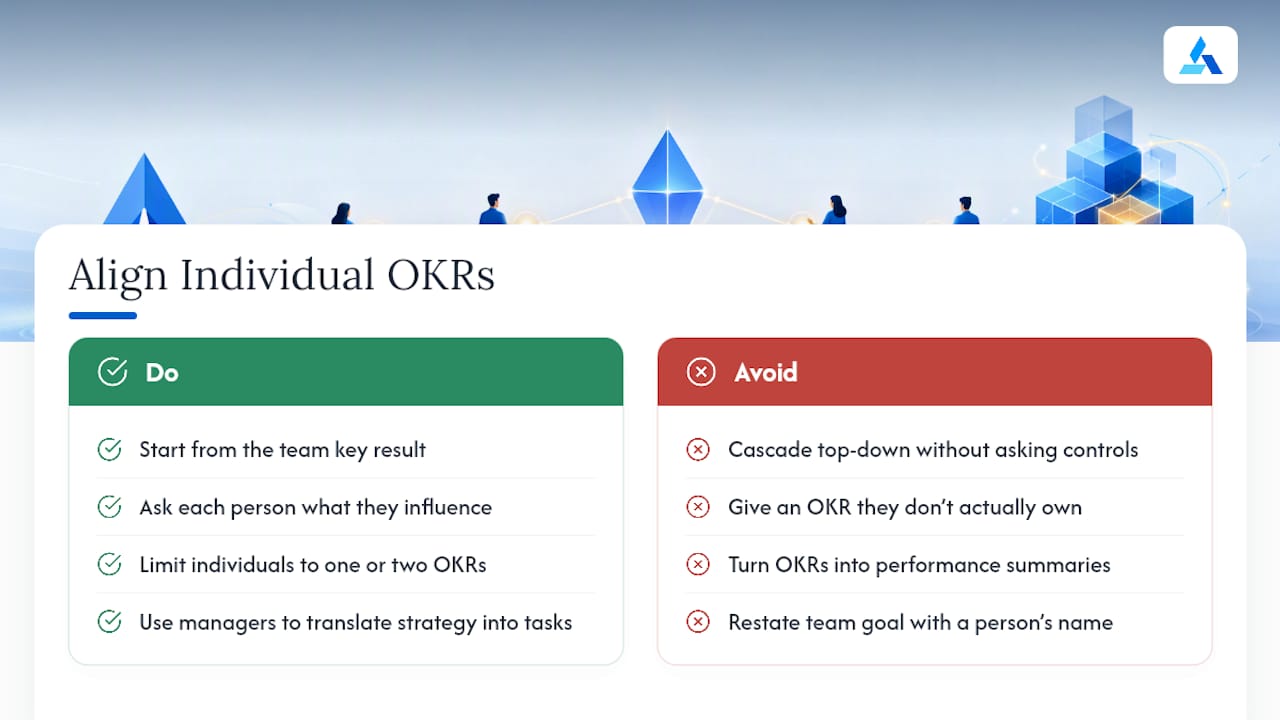
Individual OKRs should trace back to a team key result, not exist as a parallel wish list someone fills out for their annual review. The most common failure here is cascading top-down without asking what each person actually controls. If an individual’s OKR depends entirely on someone else’s work, it’s not theirs to own.
Start from the team’s key results and ask each person: what’s the one thing you influence that moves this number? That becomes their objective. A support team key result like “cut average resolution time to 4 hours” might cascade into an individual OKR around mastering a specific ticket category, not a vague restatement of the team goal with their name attached.
Keep individual OKRs to one or two, tied directly to a team key result, and resist the urge to make them comprehensive performance summaries. That’s what performance reviews are for. Managers carry real weight here. Research on OKR adoption consistently flags managers as the critical translation layer between executive strategy and daily work, and many managers report low confidence translating high-level objectives into something a team member can act on Monday morning.
A quick gut check for alignment: if you handed someone their individual OKR without context, could they explain which company objective it serves? If not, the cascade broke somewhere between the team session and the individual conversation, and that’s worth fixing before the next cycle starts, not after.
How Should You Communicate OKRs for Transparency?
Publish every OKR somewhere everyone can see it, including the ones that are behind. The instinct to hide a struggling key result until it looks better is exactly what turns OKRs into theater instead of a management tool.
A few practices make transparency stick rather than becoming a one-time announcement:
- Post objectives and current confidence scores in a shared space, updated weekly, not quarterly.
- Share the “why” behind each objective, not just the number. People commit harder to context than to targets.
- Let struggling key results stay visible. A red status with a stated blocker builds more trust than a quietly revised target.
- Give leadership a standing forum, like the monthly roundup mentioned earlier, where they respond publicly to what teams report rather than reviewing it privately and never following up.
The goal is a culture where a stalled key result triggers a conversation, not a cover-up. Teams that see leadership react constructively to red status early tend to report their own numbers more honestly, which is the entire point of running this system in the first place.
How Do You Improve Your OKR Process Over Time?
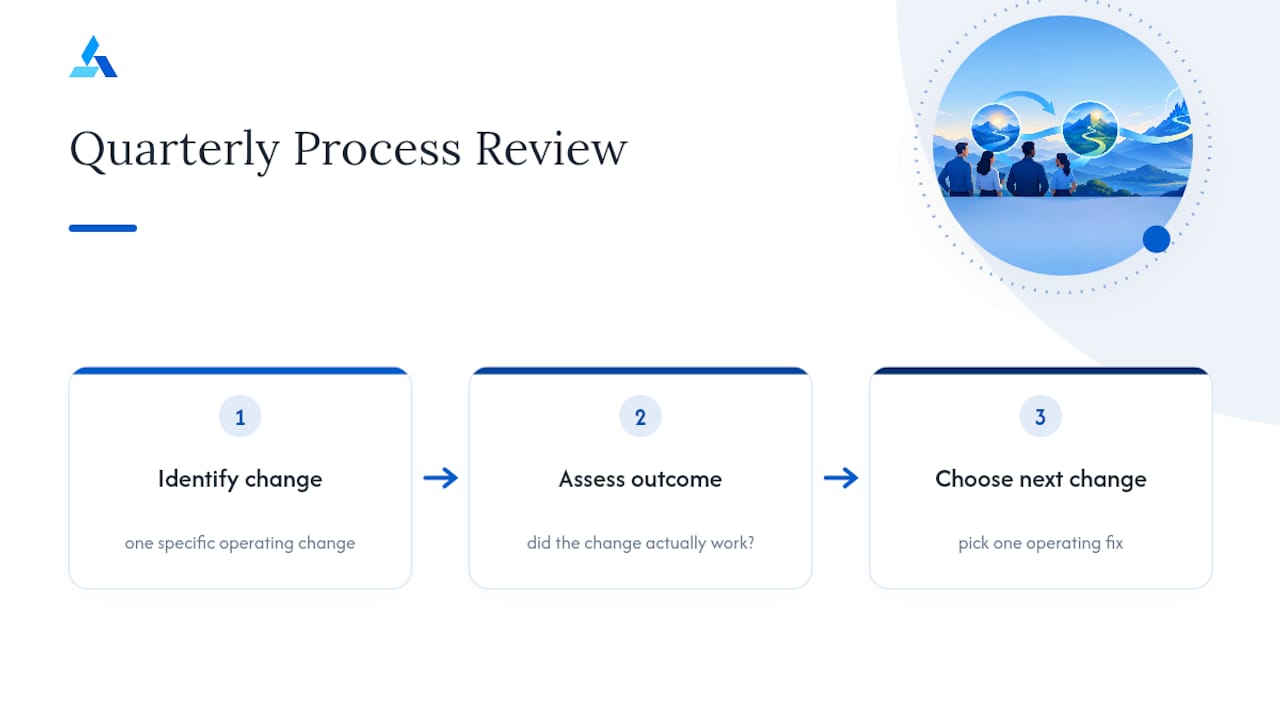
Every quarter should leave you with one specific change to how you run OKRs, not just what you set as targets. Treat the operating process itself as something with its own retrospective.
Look at patterns across cycles: are the same categories of key results missing quarter after quarter? Are certain teams consistently sandbagging targets to guarantee a good score? Are check-ins turning into status recitations instead of honest confidence conversations? Each of these has a specific fix, whether it’s retraining on outcome drafting, adjusting the scoring conversation, or replacing a facilitator who’s lost the room.
Academic research on OKR practices found real correlations between disciplined implementation and both performance and employee satisfaction, but the comparative study published in IEEE Engineering Management Review is careful to note this is association, not proof of guaranteed causation. That distinction should shape how you talk about OKRs internally: they’re a strong operating discipline, not a magic lever that fixes strategy problems on their own.
Build a lightweight quarterly process review alongside your OKR review. Ask what specifically changed since last quarter, and whether that change actually worked before you decide what changes next.
Author Perspective: Manager Enablement and Common Cultural Blockers
The gap between a good OKR framework and a failed rollout is almost always managers, not executives. Leadership signs off on the strategy anchor in an afternoon. Managers spend the next three months trying to translate it into something their team can act on without live coaching, and most get zero training for that job.
Two things I’d flag for any leader starting this: don’t punish a low score in the first two cycles, and resist tying OKRs to compensation before the team trusts the system enough to report honestly. Once bonuses are on the line, every key result gets written to be safely achievable, and you lose the entire point.
For the first two cycles, your checklist is short: train managers before you train individual contributors, keep scoring conversations about learning rather than judgment, and watch for sandbagged targets. That’s where the real work lives.
— Colin Bowdery
Blue Prysm: Guided OKR Rollout Without the Consultant Price Tag
Blue Prysm gives you the templates, cadence tooling, and strategic anchoring support this guide describes, without the multi-month engagement a traditional consulting firm charges for the same groundwork. If you want the strategy anchor and OKR tracking built into one system instead of stitched together across a spreadsheet and three separate tools, the platform pairs OKR and KPI tracking with a business strategy framework library so your team isn’t drafting objectives from a blank page.
For organizations that want hands-on facilitation through the first two cycles rather than building that muscle alone, Blue Prysm’s AI Operational Audit and Corporate & Growth Strategy engagements work through the anchoring session and pilot design with you directly. If you’d rather build internal capability and certify your own OKR champions, the Strategic Landscape and Framework Mastery training programs cover that path. Managers who need live facilitation practice specifically can also start with this manager-focused OKR training resource.
Choose the managed engagement if your leadership team has never run a strategic anchoring session before. Choose the training path if you already have a strategy lead who just needs a framework. Either way, start by checking Blue Prysm’s plans, which run from $30 a month on the Starter plan to $1,000 a month for Enterprise, and book a discovery call to scope your pilot before your next quarter starts.
Sources
FAQ
How Long Should an OKR Pilot Run?
Run your pilot for at least two full quarters before expanding to other teams. This gives you enough cycles to fix drafting mistakes and cadence habits, and enterprise rollout guidance treats a two-cycle minimum as standard before scaling.
Should OKR Scores Affect Compensation?
Not during the first rollout. Separating scoring from pay preserves honest reporting while teams are still learning to write and track key results, a practice recommended in OKR implementation guidance from the OKR Institute.
What’s a Good Example of a Measurable Key Result?
A strong key result states a baseline, a numeric target, a deadline, and an owner, such as “Reduce onboarding time from 14 days to 9 days by end of Q2.” Avoid activity-based phrasing like “improve onboarding,” which can’t be scored objectively.
Does Blue Prysm Help With OKR Tracking Specifically?
Yes. Blue Prysm’s platform includes OKR and KPI tracking alongside execution dashboards, and current pricing is listed on the Blue Prysm pricing page, starting at $30 a month for the Starter plan.
How Many Objectives Should a Team Have Per Quarter?
Keep it to 3 to 5 objectives per team, each with 2 to 5 key results. Beyond that range, teams tend to lose focus and the OKRs start functioning as a task list instead of a strategic filter.