
OKRs set the change you want. KPIs measure the health you maintain. The industry’s clearest framing, from What Matters, treats OKRs as ambitious, timeboxed goals and KPIs as ongoing indicators like revenue or churn. We built our own platform around exactly this distinction, and this article shows you how to put both to work without drowning your team in metrics.
TL;DR:
- Metrics like uptime can serve both as KPIs for stability and Key Results for specific improvements, depending on the context.
- Only 3 to 5 KPIs should be tracked at once to avoid overload, with each linked directly to decision-making processes.
- Use KPI baselines to set realistic Key Result targets, but always run feasibility checks for interdependent metrics before committing.
- OKRs are most effective during periods of change such as scaling or transformation, while KPIs maintain steady operational health.
- The same metric, like customer satisfaction, can be a continuous KPI and a targeted Key Result within the same quarter.
What OKRs and KPIs actually measure
An Objective is a short, ambitious statement of where you want to go. Key Results are the three to five measurable outcomes that tell you whether you got there, inside a fixed window, usually a quarter. A Key Result is not a task. “Launch the new pricing page” is a to-do item wearing a disguise. “Increase trial-to-paid conversion from 12% to 18%” is a real Key Result because it describes a change in the world, not a box you checked.
A KPI, by contrast, is a number you watch continuously because it tells you whether the business is healthy, and for SaaS businesses, using specialized product analytics can help track these vital metrics effectively. Not every metric deserves KPI status. A KPI earns its place by connecting directly to a decision someone will make if the number moves. Revenue per employee is a KPI. The number of blog posts published last week usually is not.
KPIs tend to fall into four buckets:
- Operational: cycle time, on-time delivery, ticket resolution speed.
- Financial: gross margin, customer acquisition cost, monthly recurring revenue.
- Adoption: active users, feature uptake, seat utilization.
- Quality: defect rate, NPS, churn.
Key Results also split into two flavors. Output KRs describe the result itself, like revenue or conversion rate. Input KRs describe the controllable actions that should produce that result, like “ship three onboarding experiments.” Strong OKRs usually blend both, as What Matters notes: inputs give you something to control, outputs tell you whether it worked.
Purpose, timeframe, and ambition: the real differences
The confusion between OKRs and KPIs almost always comes down to mixing up maintenance with change. KPIs exist to keep something stable. OKRs exist to move something that is currently stuck.
A few distinctions settle most arguments in a planning meeting:
- Purpose: KPIs monitor steady-state health; OKRs drive a specific, chosen change.
- Timeframe: KPIs run continuously with no end date; OKRs live inside a quarter or similar cycle.
- Ambition: KPIs target sustainable, realistic performance; OKRs are allowed to be a stretch, even if you only hit 70%.
- Ownership: KPIs often belong to a function or system; OKRs belong to a team committing to a specific outcome.
Here is the decision rule we use when a leader asks whether a metric should become a Key Result: if the number is currently acceptable and you just need to keep it there, leave it as a KPI. If the number is currently a problem and closing the gap requires coordinated work across a quarter, promote it into a KR.
The same number can serve both roles at once. What Matters describes a company tracking system uptime at 99.9% as a steady KPI while simultaneously running an OKR to lift NPS from 41 to 60 in 90 days, two metrics, two different jobs. Research on interdependent operations metrics finds that inventory, throughput, and cycle time are mathematically coupled, so setting KPI targets without checking feasibility across related metrics often produces combinations that cannot all be hit at once.
OKR and KPI examples you can adapt this quarter
Seeing the distinction in practice beats any definition. Here are three team-level OKRs, paired with the KPIs that should already be running in the background.
- Product: Objective: make onboarding something new users finish, not abandon. Key Results: lift activation rate from 34% to 50%, cut time-to-first-value from 6 days to 2, raise week-one retention from 40% to 55%.
- Sales and marketing: Objective: build a pipeline that converts instead of just growing. Key Results: raise marketing-qualified lead to opportunity conversion from 18% to 28%, shrink average sales cycle from 45 days to 30, lift win rate on qualified deals from 22% to 30%.
- Support: Objective: make support a reason customers stay, not a reason they leave. Key Results: cut first-response time from 4 hours to 1, raise first-contact resolution from 60% to 80%, lift post-ticket satisfaction from 3.8 to 4.5.
The KPIs sitting underneath these teams, tracked continuously regardless of which OKR is active, might be: monthly active users (weekly cadence, target: steady growth), gross churn (monthly cadence, target: under 2%), and average handle time (weekly cadence, target: under 10 minutes). Notice that first-response time appears as both a KPI you watch every week and, this quarter, a Key Result you are actively trying to move. That overlap is normal. It is exactly the pattern described above: the same metric, two different jobs depending on whether it needs maintaining or fixing.
Running OKRs and KPIs on the same calendar
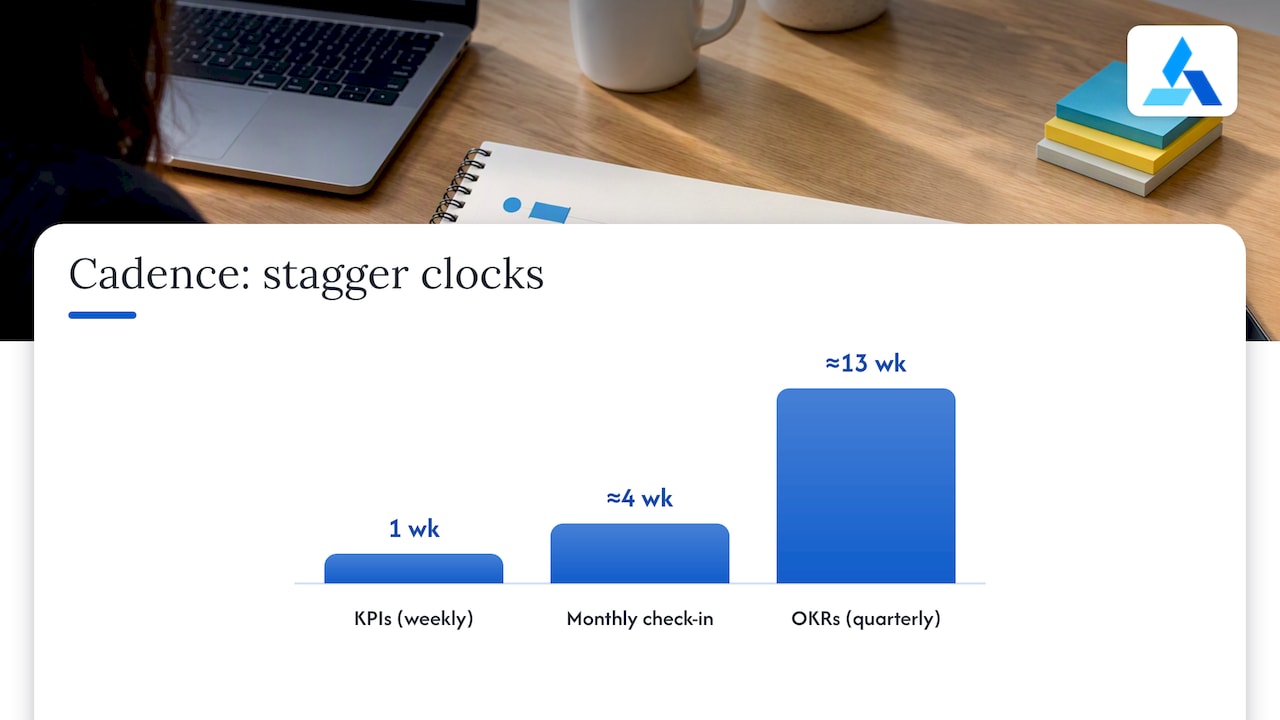
OKRs and KPIs work best on staggered clocks. Set OKRs quarterly, review KPIs weekly, and hold a monthly cross-team check-in to see whether KPI movement is validating or contradicting your quarterly bets.
The integration itself follows a simple pattern: use KPI baselines to decide what your Key Results should target, and use OKR-driven experiments to actually move the KPIs that have stalled. Before locking in a Key Result target, run this checklist:
- Data quality: is the number measured consistently, or does it depend on manual reporting?
- Ownership: does one team control enough of the inputs to move this number?
- Feasibility: does moving this KPI require another KPI to move first?
- Cross-impact: will hitting this target damage a KPI owned by another team?
A light weekly KPI review (15 minutes, same metrics, same order) paired with a monthly OKR pulse check (30 minutes, confidence scores on each Key Result) covers most of what a growing team needs. Our KPI dashboard examples and cadence planning guide walk through templates for both.
Pro Tip: Put last quarter’s KPI trend line at the top of every OKR planning doc. It stops teams from picking Key Results that sound ambitious but ignore where the number already is.
Mistakes that quietly wreck an OKR and KPI program
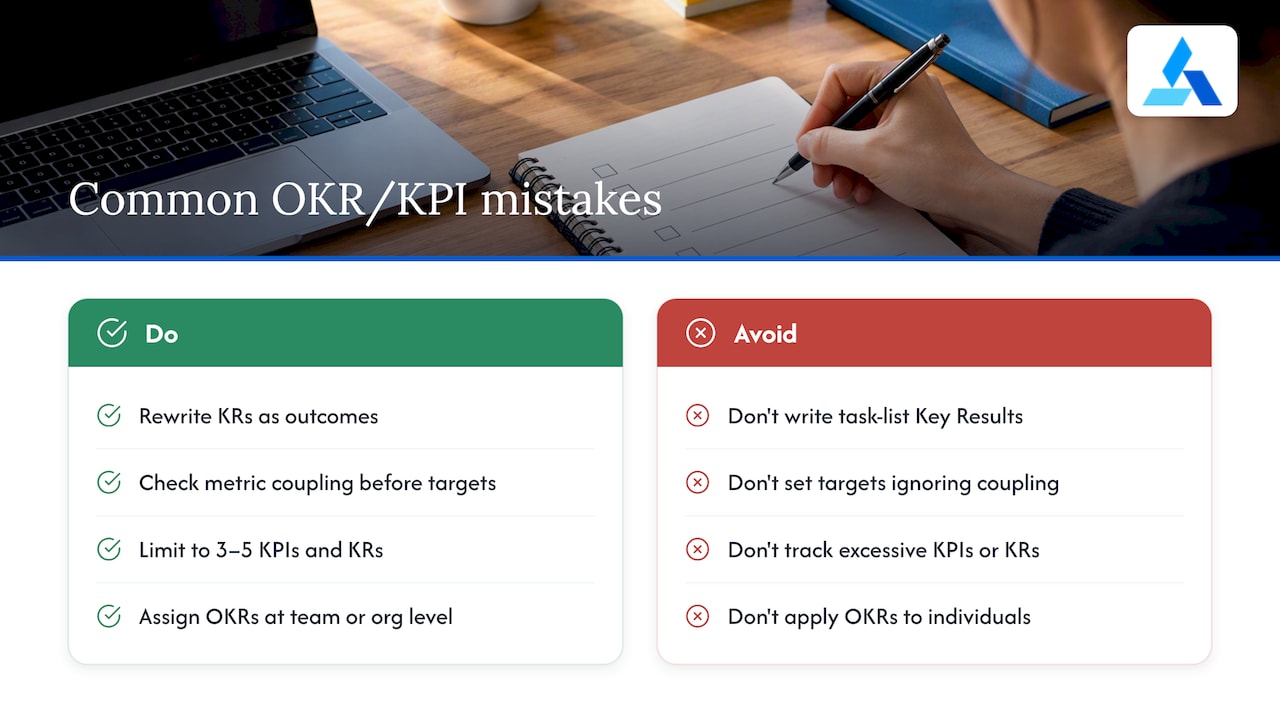
The most common failure is writing Key Results that are really task lists in disguise. “Redesign the dashboard” is not a Key Result. Rewrite it as the outcome the redesign should produce, like faster time-to-insight.
A second failure is setting KPI targets across related metrics without checking whether they can coexist. As the feasibility research on interdependent metrics shows, inventory, throughput, and cycle time move together, so a target that ignores that coupling can be infeasible by design, not by poor execution.
A third failure is sheer volume. Twelve KPIs and fifteen Key Results guarantee that nothing gets real attention. Cut to three to five of each, and protect that number ruthlessly.
The fourth, and most damaging, is applying OKRs to individuals instead of teams. Harvard Business Review found that OKRs work best at the team or organizational level, because individual OKRs tend to collapse into task lists that measure busyness instead of impact. Our KPI governance playbook covers board-to-team remedies for each of these patterns in more depth.
An 8-step checklist to align KPIs and OKRs this quarter
Most teams can run this entire sequence inside a single quarter.
- Audit your current KPIs and cut the list to the three to five that actually drive decisions.
- Set one to three company-level objectives, then translate each into team-level objectives.
- Find the KPI gaps that matter most and convert each into a timebound Key Result.
- Assign a single owner to each Key Result, along with the data source that will track it.
- Set your meeting cadence: weekly KPI reviews, monthly cross-team check-ins, quarterly OKR resets.
- Run a feasibility check on any Key Results tied to interdependent KPIs before you commit.
- Pick one OKR-driven experiment and track its effect on the underlying KPI, not just on activity.
- Review everything at the quarter boundary and carry forward only what the data supports.
Pro Tip: Treat step 6 as non-negotiable. Skipping the feasibility check is how teams end up with targets that were mathematically impossible before the quarter even started.
When OKRs matter most, and when they don’t
We favor OKRs heavily during new initiatives, scaling pushes, and transformations, any period when the real risk is picking the wrong fight. We favor pure KPI governance during stable operating periods, when the job is holding a line, not moving one. The practical takeaway: if your team cannot name what needs to change this quarter, you probably need better KPI discipline before you need another OKR cycle.
FAQ
What are examples of OKRs?
A product OKR example is: Objective: make onboarding something users finish, not abandon. The same pattern applies to sales, marketing, or support teams, one ambitious objective paired with three measurable outcomes.
What are the 5 elements of OKR?
Most OKR frameworks rely on an Objective, a set of Key Results (typically three to five), a confidence score for each Key Result, an owner responsible for driving the outcome, and a fixed time window, usually one quarter. What Matters frames the structure as ambitious, timeboxed goals paired with measurable results.
What are the 4 types of KPI?
KPIs generally fall into operational (cycle time, delivery speed), financial (margin, acquisition cost), adoption (active users, feature uptake), and quality (defect rate, satisfaction score) categories. Which types matter most depends on whether your team’s current risk is speed, cost, usage, or reliability.
What is the difference between SLA and KPI and OKR?
An SLA is a committed service threshold, often contractual, that defines the minimum acceptable performance you owe a customer or partner. A KPI is an ongoing indicator you track to judge health, whether or not it is tied to a formal commitment, while an OKR is a timeboxed goal designed to drive a specific change rather than maintain a baseline.
How do I convert a KPI into a Key Result?
Start with a KPI that is currently underperforming and matters enough to justify a quarter of focused work, then write a target and deadline for closing that specific gap. What Matters notes that the same number, like uptime or NPS, can run as a steady KPI in normal times and become a Key Result the moment you commit to moving it within a fixed window.
Sources
- What is an OKR? OKR meaning, definition & examples — What Matters
- Use OKRs to set goals for teams, not individuals — Harvard Business Review
- Beyond silo targets for interdependent KPI goal setting — Maritime Transport Conference / UPC