
Use outcome-focused frameworks such as OKRs, Balanced Scorecard, and GQM+Strategies, paired with portfolio governance and an explicit sponsorship model, to align strategy, teams, and IT. The single most important action is to measure value outcomes instead of activity, and to lock in executive sponsorship before you roll anything out. Get those two things right and the frameworks below become tools you actually use, not slideware.
TL;DR:
- Effective alignment requires measuring value outcomes rather than activity, with a clear link from team objectives to enterprise priorities.
- Start with one framework suited to your maturity level, such as OKRs for fast-moving teams or COBIT for IT governance, and pilot it with a few departments.
- Secure executive sponsorship and establish governance structures before translating strategy into a prioritized portfolio and measurable key results.
- Use outcome-based KPIs with defined owners, regular refresh cycles, and escalation paths to detect drift early and maintain strategic coherence.
- Common alignment failures stem from focusing on activity metrics, siloed teams, weak sponsorship, or rigid frameworks, which can be fixed through simplified, staged approaches.
What business alignment and business-IT alignment mean in practice
Business alignment means every team, project, and dollar of spend points toward the same strategic outcomes, not just toward busy calendars. Strategic alignment is the umbrella term: it covers whether your stated priorities match what people actually work on day to day. Business-IT alignment narrows that lens to technology: whether your systems, data, and engineering roadmap serve the goals the business is chasing, rather than running on a separate track set by whoever shouts loudest in planning meetings.
Two directions matter here, and leaders tend to only manage one.
- Vertical alignment connects enterprise strategy down through department goals to individual key results, so a frontline decision traces back to a board-level priority.
- Horizontal alignment connects departments to each other at the same level, so sales, product, and IT are not quietly working against one another while each hits their own numbers.
Most misalignment complaints are actually horizontal failures dressed up as vertical ones. A team can be perfectly aligned to its own goals and still be pulling in a direction that undercuts a neighboring team.
The vocabulary shift that makes all of this workable is moving from measuring activity to measuring value outcomes. Research on OKR adoption points to exactly this: OKRs increase transparency and bi-directional goal setting, which builds a shared vision and closes gaps between what leadership intends and what teams actually deliver. That single change in vocabulary, outcomes instead of output, is the hinge the rest of this article turns on.
Core methods and frameworks: what to use and when
There is no single framework that fixes alignment on its own. Each one solves a different piece of the puzzle, and picking the wrong one for your context wastes months. Here is the practical breakdown.
OKRs (Objectives and Key Results) work by forcing teams to set a small number of ambitious objectives, then attaching measurable key results to each one. The bi-directional setting process, where teams propose key results upward instead of only receiving targets downward, is what builds buy-in. OKRs shine in fast-moving, outcome-focused organizations where priorities shift quarter to quarter and you need everyone rowing the same direction without a six-month planning cycle. They struggle in highly regulated or slow-cadence environments where quarterly resets feel arbitrary.
Balanced Scorecard takes a different angle. Instead of cascading a handful of objectives, it forces you to track performance across four perspectives at once: financial, customer, internal process, and learning and growth. This is the right tool when your alignment problem is that finance measures one thing, customer success measures another, and nobody has a single view that connects them. It is heavier to build than OKRs and works best in organizations with enough structure to maintain quarterly scorecards without them turning into report-writing exercises.
GQM+Strategies is less well known outside measurement circles but solves a real gap: it forces you to write down the explicit reasoning that connects a goal to the strategy meant to achieve it, then attaches measurement so you can tell analytically when the connection breaks. Leaders should treat alignment as a continuous gap to close, and this approach gives you the audit trail to detect drift early rather than discovering it at year end, an idea grounded in the GQM+Strategies measurement approach. Use it when you have several teams making independent bets and you need a shared logic for why each bet should work.
Strategic Execution Framework (SEF), sometimes called portfolio alignment, tackles a different failure mode entirely: strategy that never becomes funded, prioritized work. The Strategic Execution Framework maps strategy to a funded portfolio through what it calls INVEST domains, with organizations that run transparent portfolio processes showing measurably better synthesis between what was planned and what actually shipped. This is the framework for leaders whose problem is not vision, it is that good ideas die somewhere between the strategy offsite and the engineering backlog.
COBIT is the governance language for business-IT alignment specifically. It gives you a goals cascade, moving from stakeholder needs to enterprise goals to alignment goals, so IT investment decisions trace back to something the business actually asked for. COBIT’s goals cascade helps map stakeholder needs to enterprise priorities and assess digital maturity before you commit to new capabilities. The mistake most organizations make is trying to implement the entire standard at once. Start with the goals cascade and the APO02 steps, and treat the rest as a reference shelf, not a checklist to complete.
Performance management systems (PMS) are the connective tissue that makes all of the above stick. A multi-industry empirical study on performance management systems found that integrated PMS, combining goal cascading, real-time feedback, and incentives tied to outcomes, produces higher strategic coherence and better cross-functional coordination than any framework used in isolation.
Pro Tip: Pick one framework to pilot based on your governance readiness, not your ambition: a company that cannot run a monthly portfolio review has no business attempting a full Balanced Scorecard rollout in the same quarter.
Use this checklist before you commit:
- Small team, low digital maturity: start with OKRs alone, skip governance overhead until you have a working cadence.
- Mid-size, multiple departments, funding disputes: start with Strategic Execution Framework portfolio alignment before adding OKRs on top.
- IT and business reporting separately: start with COBIT’s goals cascade to build shared vocabulary before picking a delivery framework.
- Fast change, need early warning on drift: add GQM+Strategies measurement logic to whatever framework you already run.
Step-by-step implementation: from strategy to aligned work
Frameworks fail in the rollout, not the design. Here is the sequence that holds up.
- Set sponsorship and governance first. Name an executive sponsor, define a decision-making cadence (monthly at minimum), and write down the funding rules before any team sets a goal. Sponsorship and governance structure are consistently named as the enabler that separates programs that stick from ones that quietly die, according to strategy-to-execution sponsorship guidance.
- Translate strategy into a prioritized portfolio. Decide your scoring criteria in advance (revenue impact, customer risk, strategic fit), map every active initiative against those criteria, and assign a single accountable owner to each one.
- Run an OKR or goal-cascade workshop. Give it two weeks: one for training on what a good key result looks like, one for teams to draft and negotiate their objectives bi-directionally with leadership. Pilot with one or two departments before rolling out company-wide. Our own playbook on fixing OKR cascading in five days covers how to keep this from sprawling into twenty objectives per team.
- Clean up resourcing and backlog hygiene. Anything on a roadmap that does not map to a portfolio outcome gets cut or paused. This step is uncomfortable and it is also the one leaders skip most often, which is exactly why misalignment persists.
- Build the adoption plan. Communicate the new priorities at least three times through different channels, stand up a community of practice for goal-setting questions, and monitor early key results monthly so you catch a bad objective before it wastes a quarter.
Pro Tip: If a team cannot explain how its key result ladders up to an enterprise goal in one sentence, the key result is wrong, not the team.
Measuring alignment: KPIs, dashboards, and governance that catch drift early
Pick KPIs that measure outcomes: time-to-value, customer retention, revenue attributable to a specific initiative. Skip anything that just counts activity, tickets closed, features shipped, meetings held.
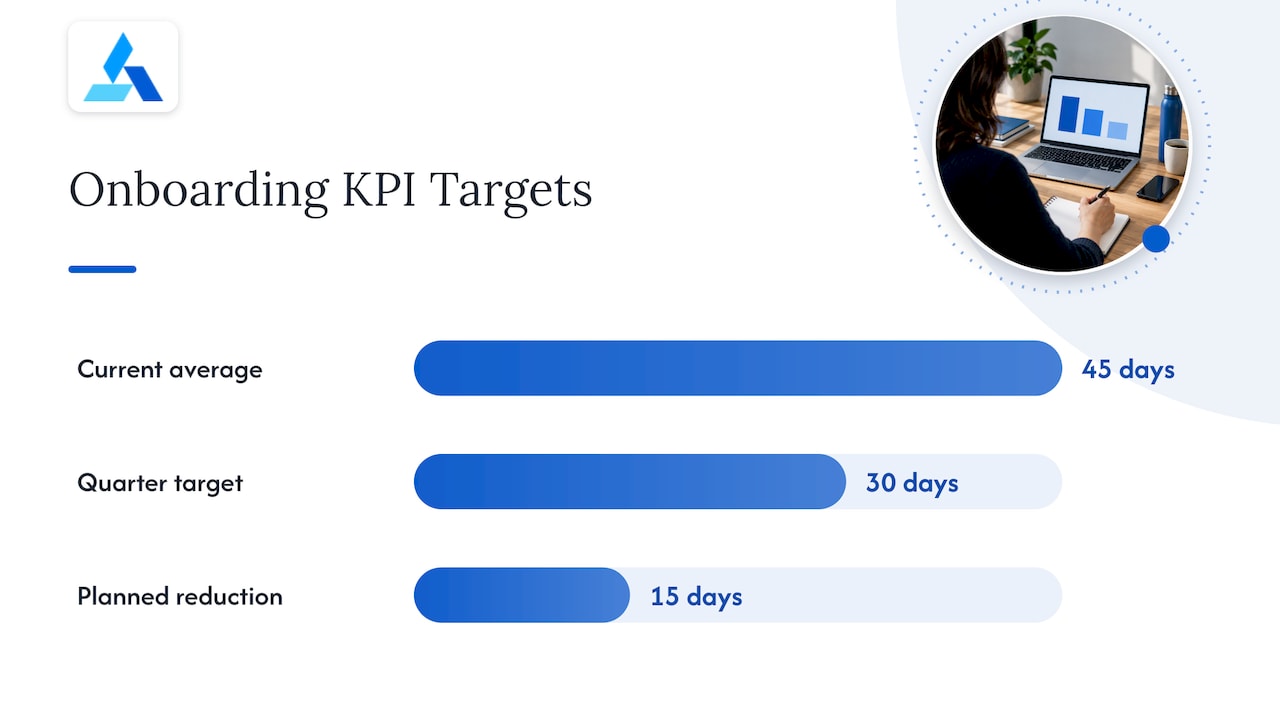
A goal cascade example makes this concrete: an enterprise goal of “grow net revenue retention” becomes an alignment goal of “reduce onboarding time for enterprise accounts,” which becomes a team key result of “cut average onboarding from 45 to 30 days this quarter.” Each level has its own owner and its own number.
KPI governance needs four things to work, and most organizations only have one or two:
- A named owner for each KPI who is accountable when it drifts.
- A fixed refresh cadence, weekly for operational metrics, monthly for strategic ones.
- Thresholds that trigger a review before the number becomes a crisis.
- A clear escalation path so a red metric reaches the sponsor, not just a dashboard nobody opens.
A multi-industry empirical study found that organizations using an integrated performance management system, with goal cascading, real-time feedback, and outcome-linked incentives, showed higher strategic coherence than those without one, according to research on performance management systems. That is the practical case for building dashboards around outcomes rather than dumping every available metric into one screen. For patterns you can copy, our breakdown of KPI dashboard examples and the six-step KPI governance playbook both walk through what a working setup looks like.
Common misalignment causes and practical remedies
Most alignment failures trace back to one of four patterns, and each has a specific fix rather than a general call for “better communication.”
- Activity-focused measurement instead of outcome measurement: reframe every metric to ask what changed for the customer or the business, then run a single OKR pilot to test the new vocabulary before rolling it out everywhere.
- Siloed teams with no shared rituals: introduce shared metrics across the teams involved and a joint planning ceremony, with a cross-functional sponsor accountable for the seam between them.
- Weak sponsorship or resources spread too thin: add a portfolio review gate where funding gets reallocated away from initiatives that no longer map to a live outcome.
- Rigid framework use, treating COBIT or any standard as a checklist: use the framework as shared governance language instead, adopting it in stages rather than implementing the whole thing on day one.
None of these fixes require new headcount. They require a leader willing to say no to work that does not map to an outcome, which is usually the actual blocker.
Where to start if you’re leading this alone
Pick one framework, not three. Secure a sponsor who will actually show up to monthly reviews, run a single OKR pilot with two teams for one quarter, and measure whether the key results moved a real outcome. Adjust the governance based on what you learn, then scale only the parts that worked. Alignment is a loop, not a launch.
Sources
- Bridging the gap between people and strategy through a shared vision: The central role of Objectives and Key Results
- Bridging the Gap between Strategy and Execution: An Empirical Study of Performance Management Systems
- Using COBIT 2019 to plan and execute an organization transformation strategy (ISACA)
- Framework to align strategy and execution (PMI)
FAQ
What are four types of alignment?
Leaders commonly distinguish vertical alignment (strategy cascading down to teams), horizontal alignment (departments coordinating with each other), strategic alignment (goals matching daily work), and business-IT alignment (technology serving business priorities). Each type addresses a different failure mode, so most organizations need to manage more than one at once.
What is alignment in business strategy?
Alignment in business strategy means every team, project, and budget decision points toward the same defined outcomes rather than operating on separate, disconnected priorities. It is achieved through frameworks like OKRs, Balanced Scorecard, and portfolio governance that connect enterprise goals to daily work.
What are the five main business-level strategies?
Definitions vary across strategy literature, but common versions include cost leadership, differentiation, focus (cost or differentiation within a niche), growth, and retrenchment. The article above focuses on alignment methods rather than strategy selection, so treat this as general context rather than a definitive list.
What are the three alignment options?
There is no single standard “three options” model; most frameworks instead describe alignment along vertical, horizontal, and business-IT dimensions, as covered earlier in this article. If you encounter a specific three-option model in another source, check whether it refers to a narrower context like technology alignment rather than organization-wide strategy.
How do I know if my teams are actually aligned?
The clearest signal is whether teams can trace their current work back to a specific enterprise outcome in one sentence, not a list of tasks. If key results measure activity instead of value delivered, or if departments cannot name a shared metric with a neighboring team, alignment has already slipped.